LLM REASONING
Case interpretation and advice
Uses the supplied case, retrieved evidence and explicit tool results to reason.
AGENTIC UNDERWRITING FLOW
A broader research workbench for the machinery around an underwriting decision: domain ontology, company knowledge, document extraction, retrieval, reasoning, rules, pricing and human-visible workflow.
THREE KNOWLEDGE LAYERS
The flow separates reusable insurance meaning, organisation-specific evidence and case-specific reasoning rather than compressing them into one prompt.
Uses the supplied case, retrieved evidence and explicit tool results to reason.
Supports vector retrieval or vector plus knowledge-graph retrieval with precise evidence.
Provides stable vocabulary, extraction targets and connections across source formats.
VISIBLE ORCHESTRATION
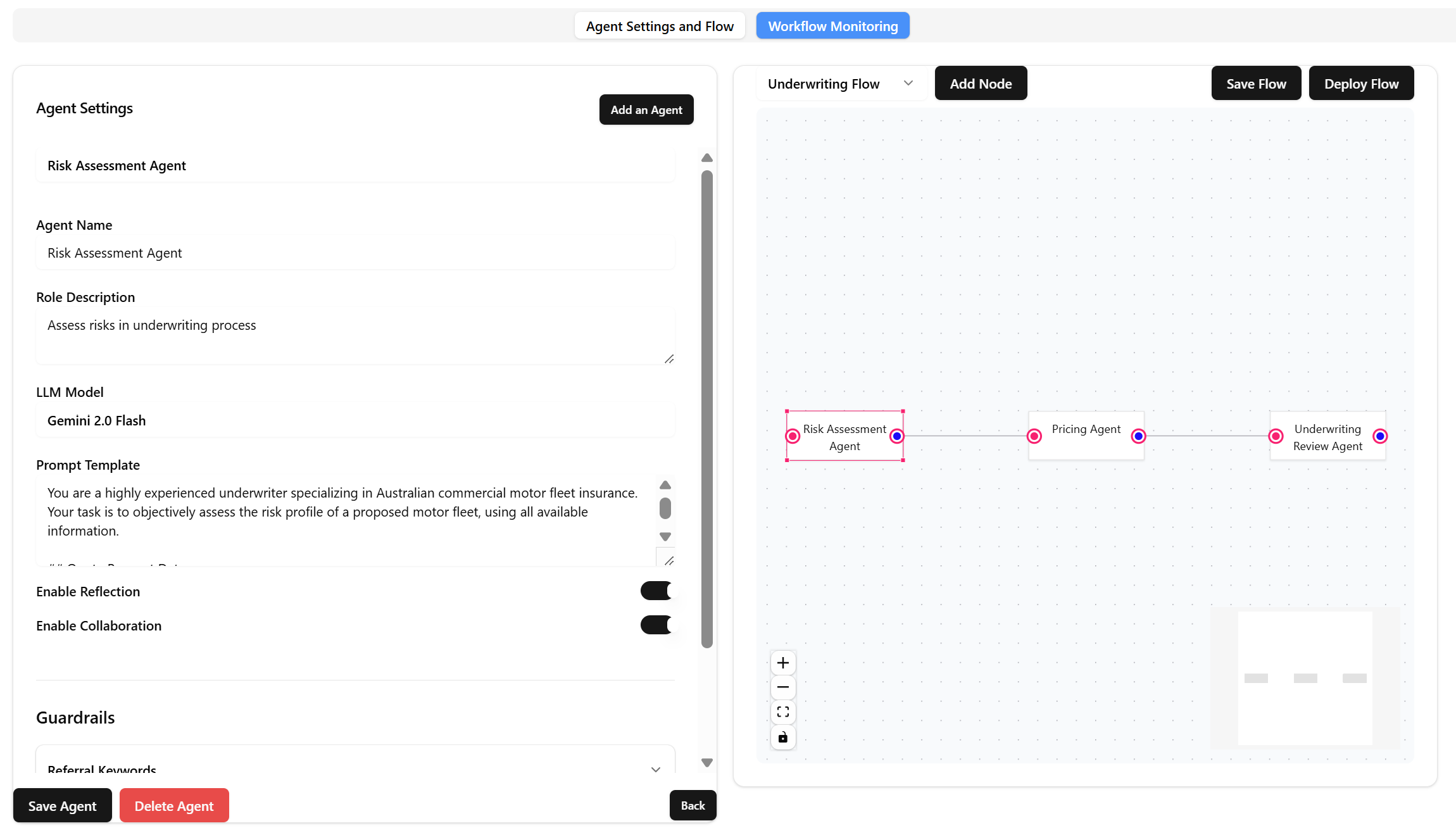
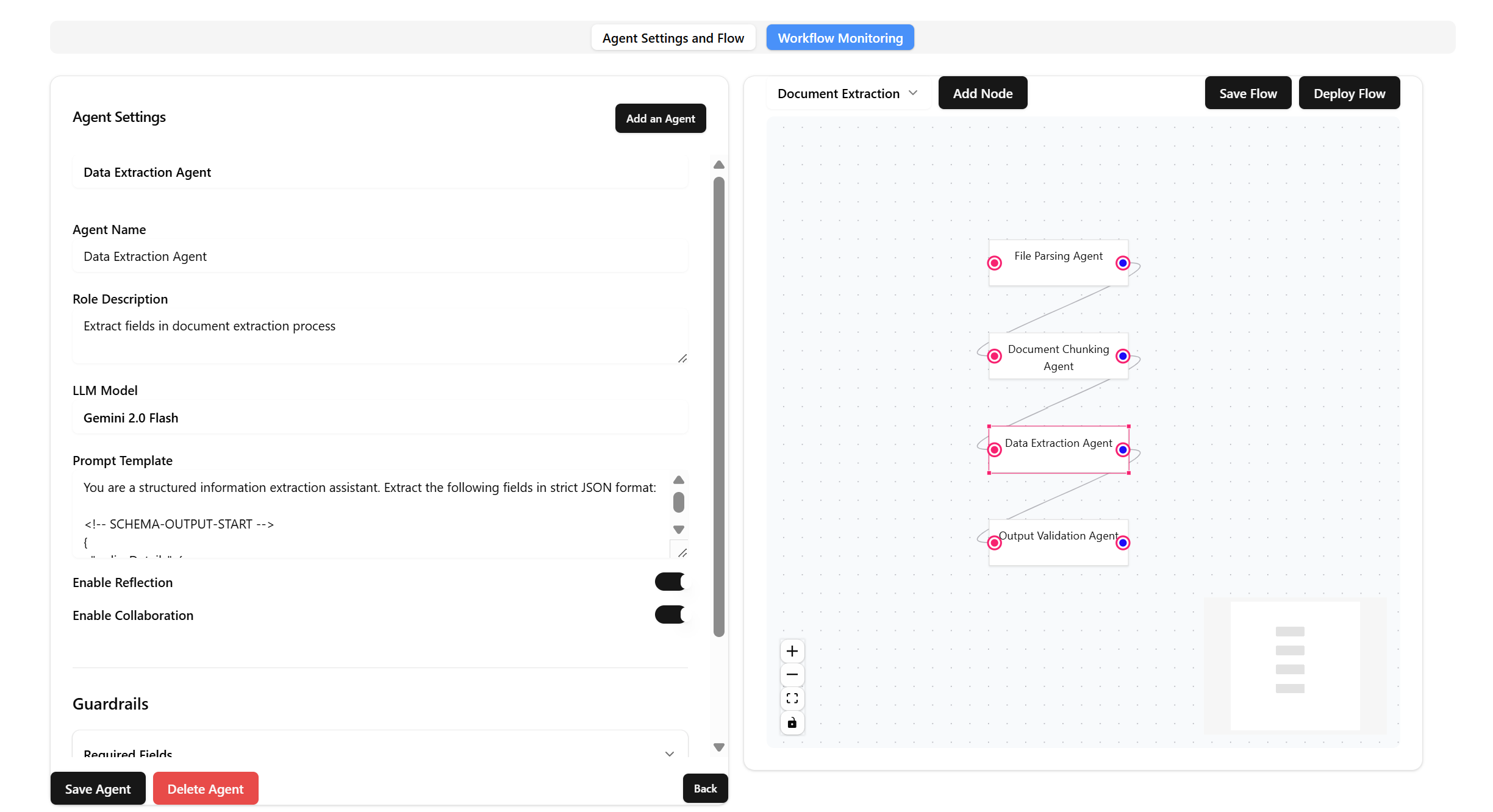
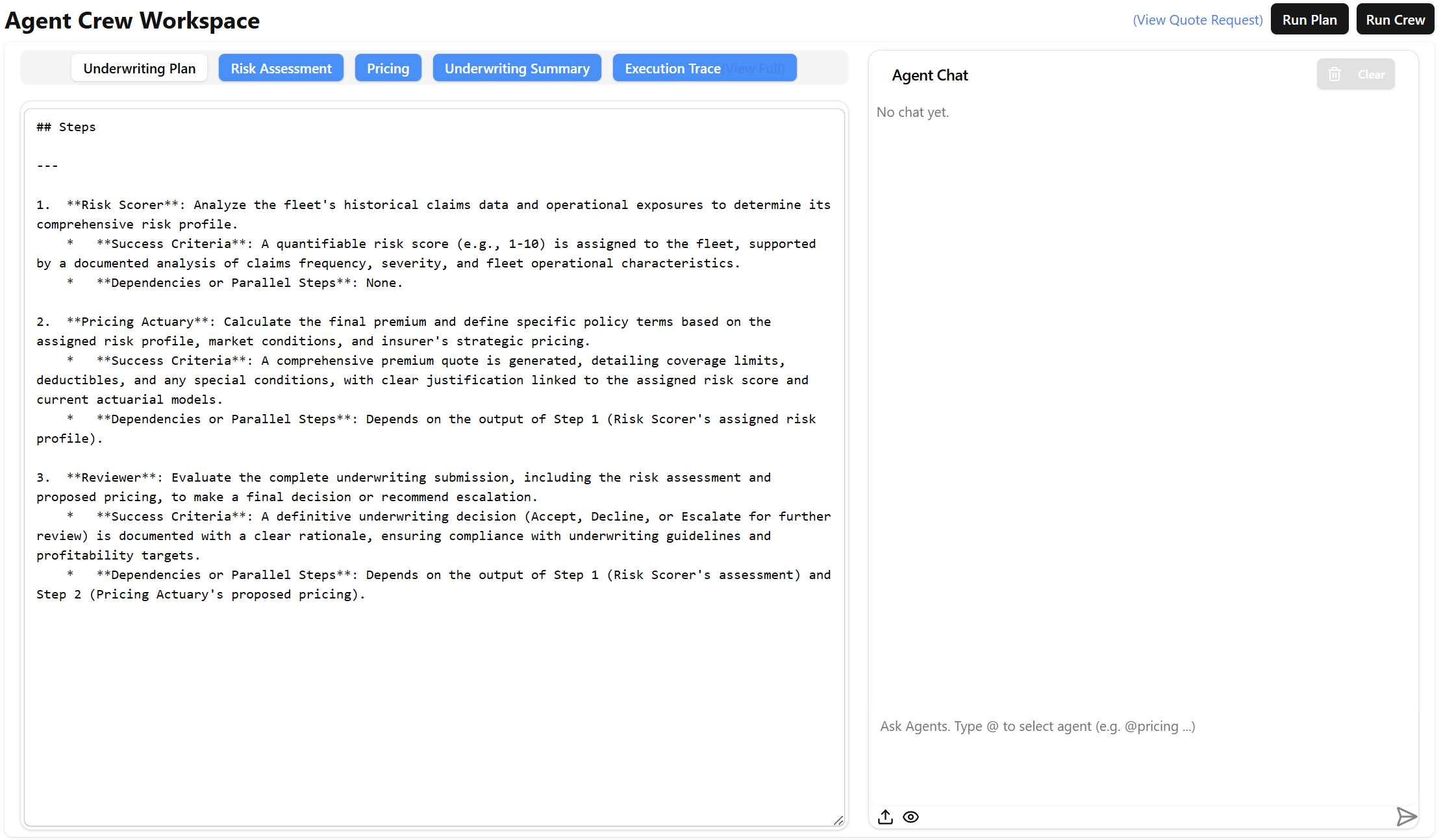
The workbench exposes agent configuration, tool assignment and execution sequence so the workflow can be analysed and changed deliberately.
THE HARD PROBLEM
AI helps propose structure from documents, tables and narrative. The target schema, ontology, validation rules and review workflow keep that interpretation bounded.
Return precise sentences and paragraphs from company documents with source context.
Use entity and relationship structure where connected evidence improves the answer.
Combine case input, ontology and retrieved company evidence without erasing provenance.
EXPERIMENTAL CONTROL
The ingestion system maintains three pipeline families. The optimised and algorithmic variants can each be run under conservative, balanced or high-recall profiles.
Retained as a reference path for comparison.
Tuned extraction and retrieval behaviour.
More explicit control over evidence classification.
SYSTEM BOUNDARY
01Ontology and schemas define the target meaning.
02Retrieval keeps answers anchored to company evidence.
03Rules and pricing execute outside free-form reasoning.
04People review exceptions and remain accountable.
ARCHITECTURE DISCUSSION
Get in touch about source ingestion, ontology design, retrieval quality, workflow orchestration or deterministic rule integration.